
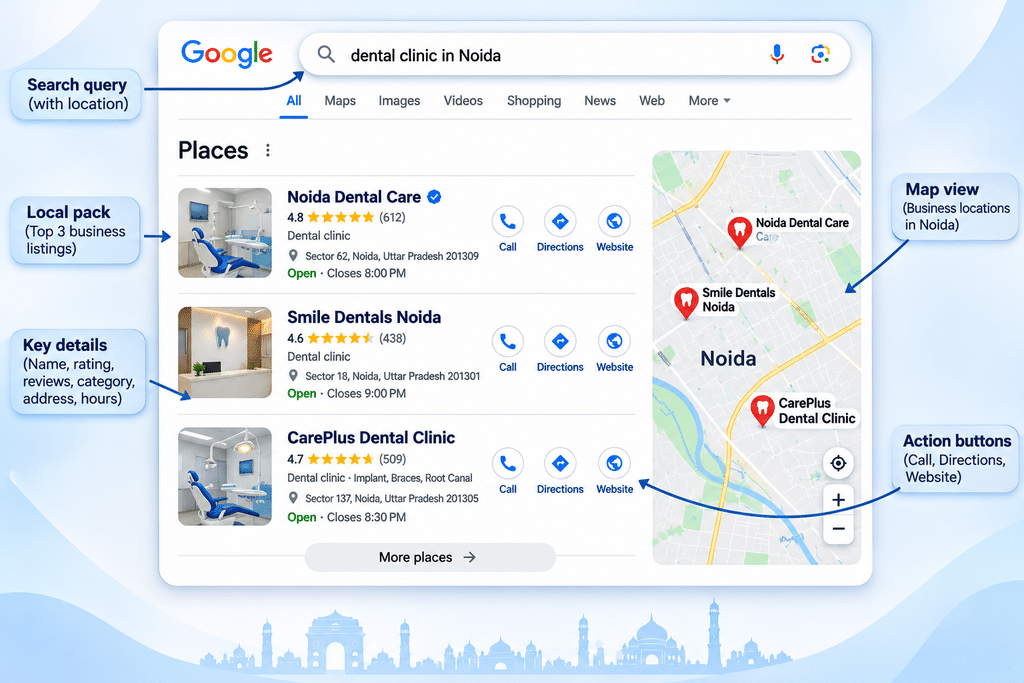
If someone in your area searches “dentist near me”, “salon in Sector 62” or “AC repair Noida”, Google shows a map with three businesses before any regular website. Local SEO is the work of getting your business into that map and the results below it. For most small businesses in India, it comes down to four things: a complete and verified Google Business Profile, a website that clearly explains each service and location, a steady flow of genuine reviews, and consistent business details across the directories your customers use.
This guide explains how Google decides which local businesses to show, what to set up first, which tactics are worth your time, and which “shortcuts” can get your profile suspended. It is written for owners who want to do the work themselves or understand what an agency should be doing for them.
What is local SEO?
Local SEO is the part of search engine optimisation focused on searches with local intent — where the searcher wants a business nearby or in a specific place. It covers your Google Business Profile (the listing that appears on Google Maps and in the local pack), your website’s location and service pages, reviews, and mentions of your business on other sites.
It differs from regular SEO in one important way: the searcher’s location changes the results. Two people searching “physiotherapist” in Indirapuram and Dwarka will see completely different businesses. You are not competing with every physiotherapist in India — only with the ones near the person searching.
How Google decides which local businesses to show
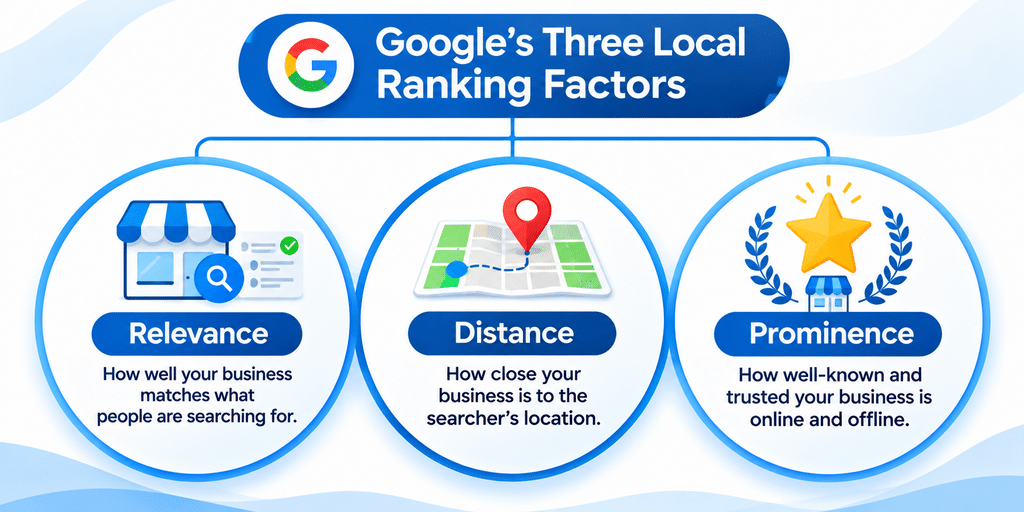
Google states that local results are mainly based on three factors. In its own help documentation, it describes them like this:
| Factor | What Google means | What you can control |
|---|---|---|
| Relevance | How well a Business Profile matches what someone is searching for | Correct categories, services, description, and website content that matches each service |
| Distance | How far each business is from the person searching | Very little — you can’t move your shop, but you can set an accurate address or service area |
| Prominence | How well-known a business is, including links to your business and the number of reviews | Reviews, local press and directory mentions, links from relevant local websites |
Google is also blunt on one point: there is no way to request or pay for a better local ranking. Anyone selling a “guaranteed #1 on Maps” is selling something Google itself says doesn’t exist.
For a more detailed view, Whitespark’s 2026 Local Search Ranking Factors survey asked 47 local SEO specialists to score 187 factors. For the map pack, their top-rated factors were the primary Business Profile category, proximity to the searcher, keywords in the business name, having a physical address in the city being searched, and being open at the time of the search. It’s an expert opinion survey, not data from Google, but it lines up closely with Google’s own guidance. The 2026 edition also noted that review signals had become more important.
Notice “keywords in the business name” on that list. It works, which is why so many listings look like “Sharma Dental Clinic – Best Dentist in Noida”. It also breaks Google’s guidelines, which say your name must reflect your real-world business name and that adding unnecessary information can lead to suspension. We’ll come back to this under mistakes.
Step 1: Set up your Google Business Profile properly
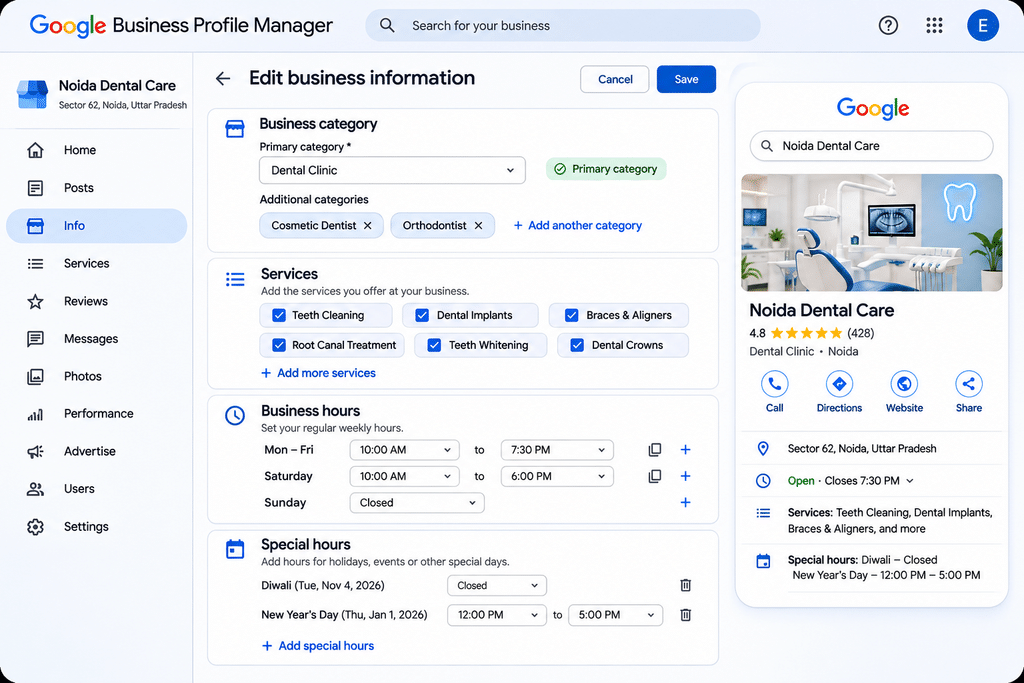
Your Business Profile is the single most important local SEO asset you own. Most profiles we audit are claimed but half-finished. Work through this list:
- Verify the profile. Unverified profiles have limited visibility and anyone can suggest edits to them.
- Use your real business name exactly as it appears on your signboard, invoices and website.
- Choose the most specific primary category. “Pediatric dentist” beats “Dentist” if that’s what you are. Add secondary categories only for services you genuinely offer.
- Add your services and products, using Google’s predefined services where they exist and writing short descriptions for custom ones.
- Set accurate hours, including special hours for Diwali, Holi and other closures. Being open when someone searches matters.
- Write a plain description of what you do, who you serve and which areas you cover. No phone numbers or URLs in it.
- Upload real photos of your shopfront, interior, team and work. Google’s guidance favours real images; stock photos add nothing.
- Add attributes such as wheelchair access, women-led, online appointments or languages spoken.
Storefront, service-area or hybrid?
If customers come to you (a clinic, salon or restaurant), show your address. If you go to customers (pest control, plumbers, interior designers working on-site), Google asks service-area businesses to hide their address and set a service area instead — generally no more than about two hours’ drive from your base. If you do both, you can show the address and add a service area.
Google does not allow profiles for virtual offices or mailing addresses where you don’t actually operate. Co-working spaces are allowed only if you have clear signage, receive customers there and the space is staffed by your own people during business hours. Many Indian startups and consultants get caught out here.
Step 2: Build website pages that match local searches
Your Business Profile links to your website, and Google uses that site to judge relevance. In the Whitespark survey, a dedicated page for each service was the top factor for local organic results.
In practice, that means:
- One page per core service (“root canal treatment”, “bridal makeup”, “home loan advisory”), not one page listing everything.
- Location pages only where you have a real presence or genuinely serve the area, each with unique content — directions, local landmarks, team at that branch, area-specific FAQs. Swapping the city name on a template doesn’t count.
- Your name, address and phone number (NAP) in the footer or contact page, matching your Business Profile exactly.
- LocalBusiness structured data (or a more specific type like Dentist or Restaurant) with your address, hours and phone number.
- Content that reflects how your customers actually search, including Hinglish terms like “AC service wala near me” or “tiffin service Noida” if that’s what people type.
Step 3: Earn reviews the right way
Reviews affect both rankings (Google lists review count under prominence) and whether people choose you once they find you. BrightLocal’s 2026 consumer survey of US adults found that 97% read reviews for local businesses, 74% only care about reviews from the last three months, and 89% expect owners to respond. That data is from the US, but anyone who has compared two clinics on Google Maps in India will recognise the behaviour.
A simple system works better than occasional bursts:
- Get your review link or QR code from your Business Profile.
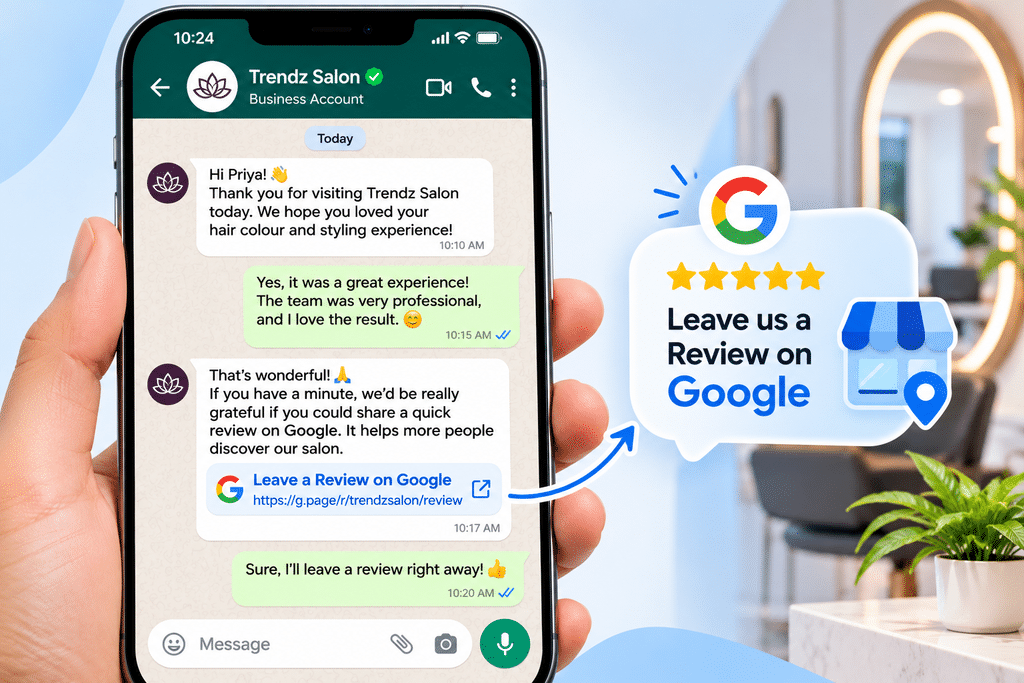
- Ask every customer at the natural moment — after a successful treatment, at billing, or in a WhatsApp message the same day.
- Reply to every review, positive or negative, within a few days. Keep replies specific and never promotional.
- Track monthly review count and average rating so you notice when the flow slows.
What you must not do: Google’s review policy strictly prohibits offering incentives — discounts, free services, gifts — in exchange for reviews, and requires every review to reflect a genuine experience. Buying reviews, asking staff to post them, or offering “10% off for a 5-star review” can get reviews removed and restrictions placed on your profile.
Step 4: Get consistent citations on the directories that matter in India
A citation is any mention of your business name, address and phone number on another website. In India, the obvious ones are Justdial, IndiaMART (for B2B), Sulekha, and industry platforms such as Practo for doctors, Zomato and Swiggy for restaurants, or MagicBricks and 99acres for property businesses. Also include your local trade association, chamber of commerce and city-specific directories.
The goal isn’t hundreds of listings. Whitespark’s survey found traditional citations have lost a little importance as a ranking factor. What matters is that the important listings exist and the details match. A clinic that moved from Sector 18 to Sector 50 three years ago and never updated Justdial is sending Google mixed signals.
There’s a newer reason to care: the same survey found that three of the top five factors for visibility in AI search tools were citation factors. When ChatGPT, Gemini or Google’s AI Overviews recommend local businesses, they draw on what the wider web says about you, not just your own site. We cover this in more detail in our guide to AI visibility tracking.
What changed in Google Business Profile recently
Two changes are worth knowing about. First, Google discontinued the Questions & Answers section on Business Profiles in late 2025, so you can no longer seed your own FAQs there. Answers to customer questions are increasingly generated from your profile, reviews and website — another reason to keep a proper FAQ section on your site. Second, Google has been expanding AI features in Search and Maps, including tests of AI-assisted calling and review replies. Treat these as features to watch rather than tactics to build a strategy around.
Common local SEO mistakes that cost Indian businesses visibility
- Keyword-stuffed business names. It may lift rankings briefly, but competitors can report it, and Google’s guidelines say it can lead to suspension. Recovering a suspended profile can take weeks.
- Multiple profiles for one location. Google allows one profile per location. Duplicates split your reviews and can trigger suspensions.
- Registering a virtual office to appear in a more profitable area.
- Letting an old employee or past agency own the profile. Make sure the business owner is the primary owner and agencies are added as managers.
- Ignoring negative reviews. A calm, specific reply often does more for the next customer than the review did harm.
- Expecting results in two weeks. Profile fixes can show impact within weeks, but competitive categories in metros usually take several months of consistent work.
A simple local SEO checklist
| Task | How often |
|---|---|
| Verify profile, fix name, category, hours, services | Once, then check quarterly |
| Update special hours for holidays and festivals | Before each holiday |
| Ask for reviews and reply to all new ones | Weekly |
| Post updates, offers or new photos on the profile | Two to four times a month |
| Check NAP on Justdial and key industry directories | Every six months, and after any move |
| Review Business Profile insights (calls, directions, website clicks) | Monthly |
| Add or improve one service or location page | Monthly |
Frequently asked questions
How long does local SEO take to show results?
Fixing an incomplete or wrongly categorised Business Profile can improve visibility within a few weeks. Ranking in the map pack for competitive searches in a metro city usually takes three to six months of steady reviews, content and citation work. Low-competition categories in smaller towns can move faster.
Is Google Business Profile free?
Yes. Creating, verifying and managing a Business Profile costs nothing. You pay only if you hire someone to manage it or run Google Ads, which can also appear in local results but are separate from organic Maps rankings.
Can I rank in an area where I don’t have an office?
For the map pack, it’s difficult, because distance is one of Google’s three core factors. Service-area businesses can set a service area, but the profile still ranks most strongly near its base. For other areas, location pages on your website and Google Ads are more reliable routes.
Should I put keywords in my business name?
No, unless the keyword is genuinely part of your registered and displayed name. Google’s guidelines don’t allow extra information in the name, and profiles that do it risk suspension. Put service keywords in your categories, services, description and website instead.
Do Justdial and IndiaMART listings help SEO?
They help as citations — consistent mentions that confirm your business details — and they can send leads directly. They won’t make you rank on their own. Prioritise accuracy on the few platforms your customers actually use over listing on hundreds of low-quality directories.
Is it okay to offer a discount to customers who leave a review?
No. Google’s review policy strictly prohibits incentives in exchange for reviews. You can and should ask every customer for an honest review, but you can’t reward them for it. Violations can lead to reviews being removed and restrictions on your profile.
Can I create a Business Profile for a co-working office?
Only if your business has clear signage there, receives customers at that location during business hours, and has your own staff present during those hours. A hot desk or mailing address alone isn’t eligible.
Does local SEO help with AI search tools like ChatGPT and Gemini?
Increasingly, yes. AI tools build answers from what’s published about your business across the web — your website, reviews and directory listings. Consistent information and genuine reviews make it more likely you’re described accurately, though no one can guarantee inclusion in AI answers.
How much does local SEO cost in India?
It depends on competition, the number of locations and how much content and review work is included. We break down typical monthly ranges and what each budget should buy in our guide to SEO cost in India.
Getting started
Local SEO rewards consistency more than cleverness. Start with an honest, complete and verified Business Profile, make sure your website has a clear page for each service, build a weekly habit of asking for and replying to reviews, and keep your details accurate on the directories your customers use. Avoid the shortcuts — stuffed names, bought reviews, virtual offices — because the downside is losing the profile altogether.
If you’d like a second opinion on where your business stands, our team can review your Business Profile, website and local competitors. Start with a free website audit, or see how our local SEO services work.