
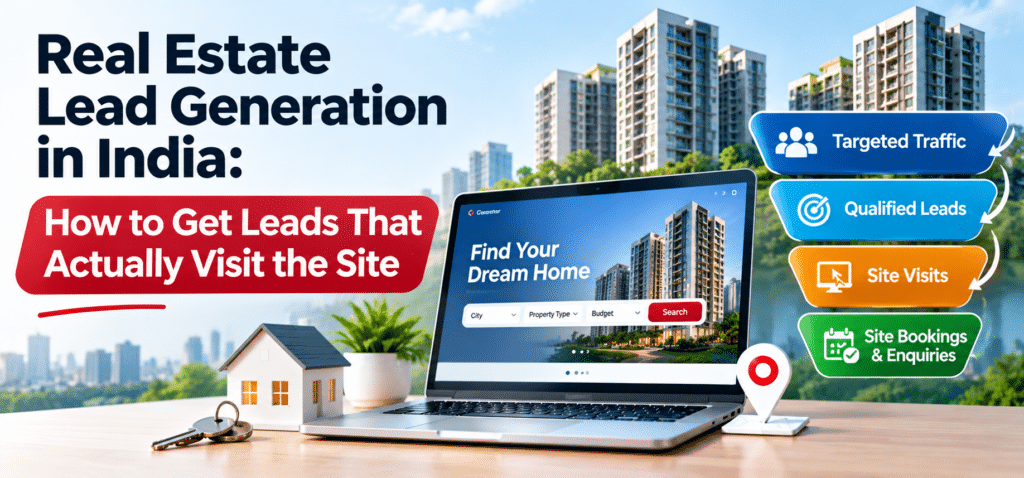
Ask any sales head at an Indian real estate project what is wrong with their marketing and you will rarely hear “not enough leads”. You will hear “the leads are junk”. Wrong numbers, people who filled a form by accident, students, brokers posing as buyers, and genuine buyers whose budget is half the ticket size.
Real estate lead generation that works in India comes down to three things: choosing channels that match the buyer’s stage, adding friction so the wrong people drop out before they reach your sales team, and calling the right people within minutes. This guide covers each of those, along with the RERA rules your ads have to follow and the numbers worth tracking — so you can judge your campaigns by site visits and bookings, not by form fills.
What is real estate lead generation?
Real estate lead generation is the process of attracting people who may buy, rent or invest in property and capturing their contact details so your sales team can follow up. A lead might come from a Google search, a Facebook or Instagram form, a WhatsApp chat, a property portal enquiry, a call from a hoarding, or a referral from a channel partner.
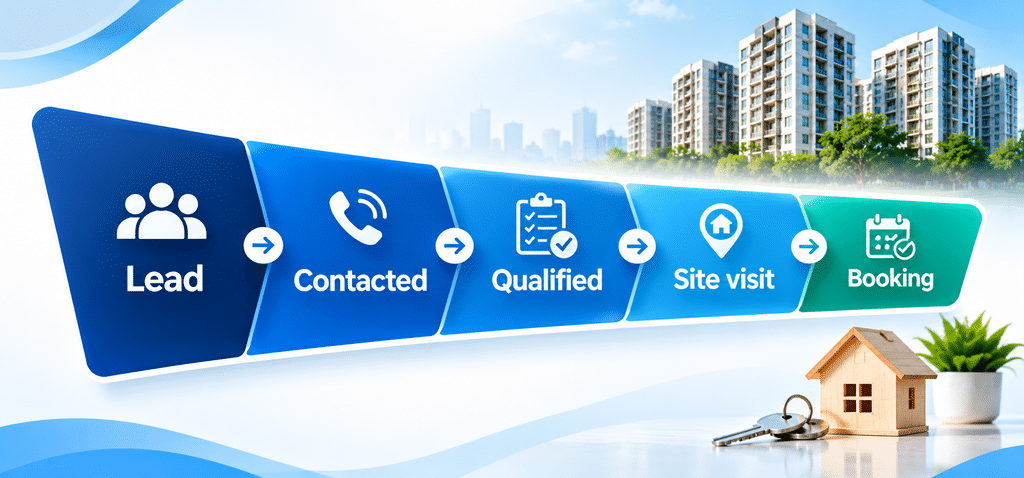
The important distinction is between a lead and a qualified lead. A lead is anyone who shares a phone number. A qualified lead has a budget that fits the project, a realistic timeline, interest in your location and configuration, and is the actual decision-maker or close to them. In residential real estate, the most useful milestone after that is the site visit, because that is where most bookings begin.
Why property leads in India are so often low quality
Before changing channels, it helps to understand why the problem exists:
- Forms that are too easy. Meta Instant Forms pre-fill name and phone number from the user’s profile. Two taps and the form is submitted, often without the person reading which project it was.
- Broad targeting with a low budget. When a ₹2 crore project is shown to everyone aged 25–55 in a city, the algorithm finds people who fill forms cheaply, not people who can afford the flat.
- Shared portal leads. Enquiries from listing portals can reach several brokers or projects at once, so your team is competing for the same buyer within minutes.
- Slow follow-up. A buyer who enquired on Saturday and is called on Monday has usually spoken to three other projects by then.
- Optimising for the wrong event. If the ad platform is told that a form fill is success, it will deliver more form fills. It does not know which of them turned into a site visit unless you tell it.
Every fix in this guide targets one of these five causes.
The main real estate lead generation channels compared
| Channel | Typical buyer stage | Lead quality | Best suited to |
|---|---|---|---|
| Google Search ads | Active — searching for a project, location or configuration | Generally higher; the searcher has expressed intent | Launched projects, branded and location searches (“3 BHK in Sector 150 Noida”) |
| Meta (Facebook/Instagram) lead forms | Passive — browsing, not searching | Mixed; depends heavily on form settings and creative | New launches, pre-launch interest, affordable and mid-segment housing, large volume |
| Click-to-WhatsApp ads | Passive to warm | Often better than instant forms, because the user starts a conversation | Projects where the team can reply quickly and share brochures, prices and videos in chat |
| Property portals (99acres, MagicBricks, Housing.com) | Active — comparing options | Good intent, but often shared and price-sensitive | Resale, rentals, ready-to-move inventory, brokers |
| SEO and project microsites | Research and comparison | High, but takes months to build | Developers with several projects in one city, long-term brand building |
| Channel partners and referrals | Warm — introduced by a trusted contact | Usually the highest conversion | Every project; often the main source of bookings for developers |
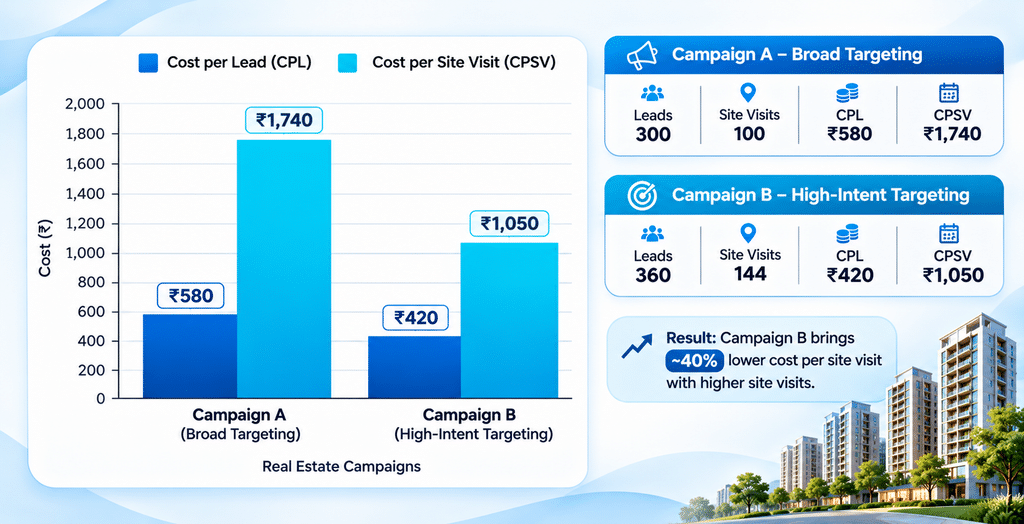
Most successful projects use a mix. Meta and WhatsApp create volume around a launch, Google Search captures people already looking, portals cover ready inventory, and channel partners close a large share of sales. The mistake is judging each channel only by its cost per lead, because a cheaper lead that never visits the site is not cheaper.
For typical cost ranges on each platform, see our guides to Google Ads cost in India and Meta Ads cost in India.
How to get better real estate leads: a step-by-step approach
1. Define who you actually want
Write down the budget range, configuration, location preference, timeline and buyer type (end user, investor, NRI) for the project. This becomes your qualification checklist, your targeting brief and the basis for your ad copy. “Luxury 3 BHK starting ₹1.8 Cr, possession 2028” in the ad itself filters out a lot of people who would never buy.
2. Put price and location in the creative
Ads that hide the price get more enquiries and fewer buyers. Showing a “starting from” price, the micro-market and possession timeline lets people self-qualify before they tap. It feels like you are losing leads; in practice you are losing leads your sales team would have discarded anyway.
3. Add the right amount of friction to forms
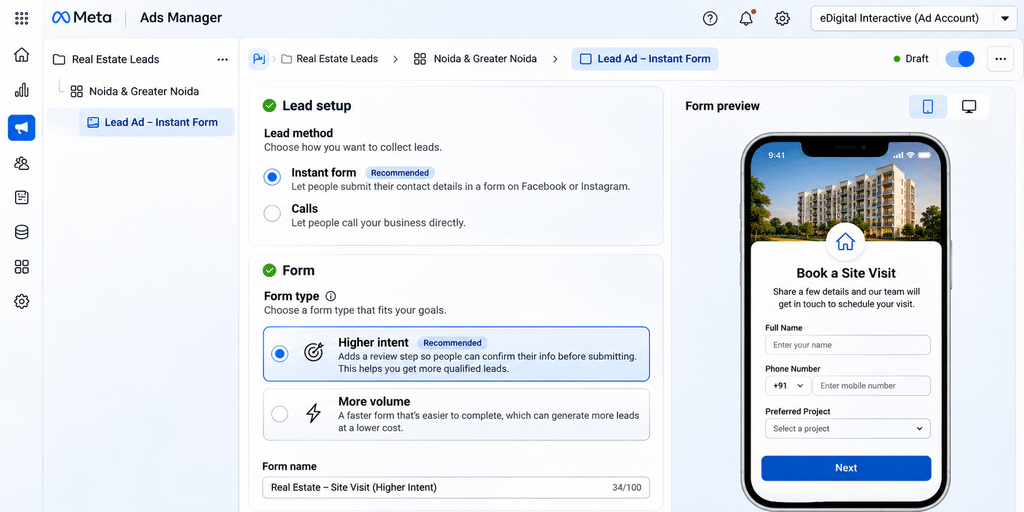
On Meta, Instant Forms let you choose a form type. The “Higher intent” option adds a review step where the user confirms their details before submitting, which is designed to filter out accidental submissions. Add one or two qualifying questions — budget range, preferred configuration, when they plan to buy — as multiple-choice answers. Each extra question lowers volume and usually raises quality. Test the balance rather than guessing.
4. Send people to a project page, not just a form
A fast, mobile-friendly landing page or microsite with floor plans, price range, location map, RERA details and a short walkthrough video gives serious buyers what they need and makes them more likely to enquire with real intent. It also gives Google a relevant page to show for project and location searches.
5. Call within minutes, not hours
Speed matters more in real estate than in most categories, because buyers enquire on several projects in the same session. Route every new lead to a CRM, notify the assigned sales person instantly, and send an automatic WhatsApp message with the brochure so the buyer has something to look at before the call. Weekends matter: many enquiries arrive on Saturday and Sunday, when site visits are also most common.
6. Qualify consistently and record outcomes
Use the same three or four questions on every call and record the answer in the CRM: interested and qualified, interested but outside budget, not reachable, wrong number, broker, not interested. Over a few weeks this tells you exactly which campaign, ad and form is producing usable leads.
7. Feed site visits back to the ad platforms
This is the step most projects skip. Both Google and Meta can import offline conversions from your CRM. When you upload “site visit done” or “booking” events against the original lead, the bidding algorithms start finding people who resemble buyers rather than people who resemble form-fillers. It takes some setup and a few weeks of data, but it is the single biggest lever on lead quality once volume is steady.
RERA and ad platform rules you can’t ignore
Real estate advertising in India comes with disclosure rules that many campaigns still miss, especially on social media.
- RERA registration first. Under the Real Estate (Regulation and Development) Act, 2016, a project that requires registration cannot be advertised or marketed before it is registered with the state RERA authority. “Pre-launch” campaigns for unregistered projects carry real risk.
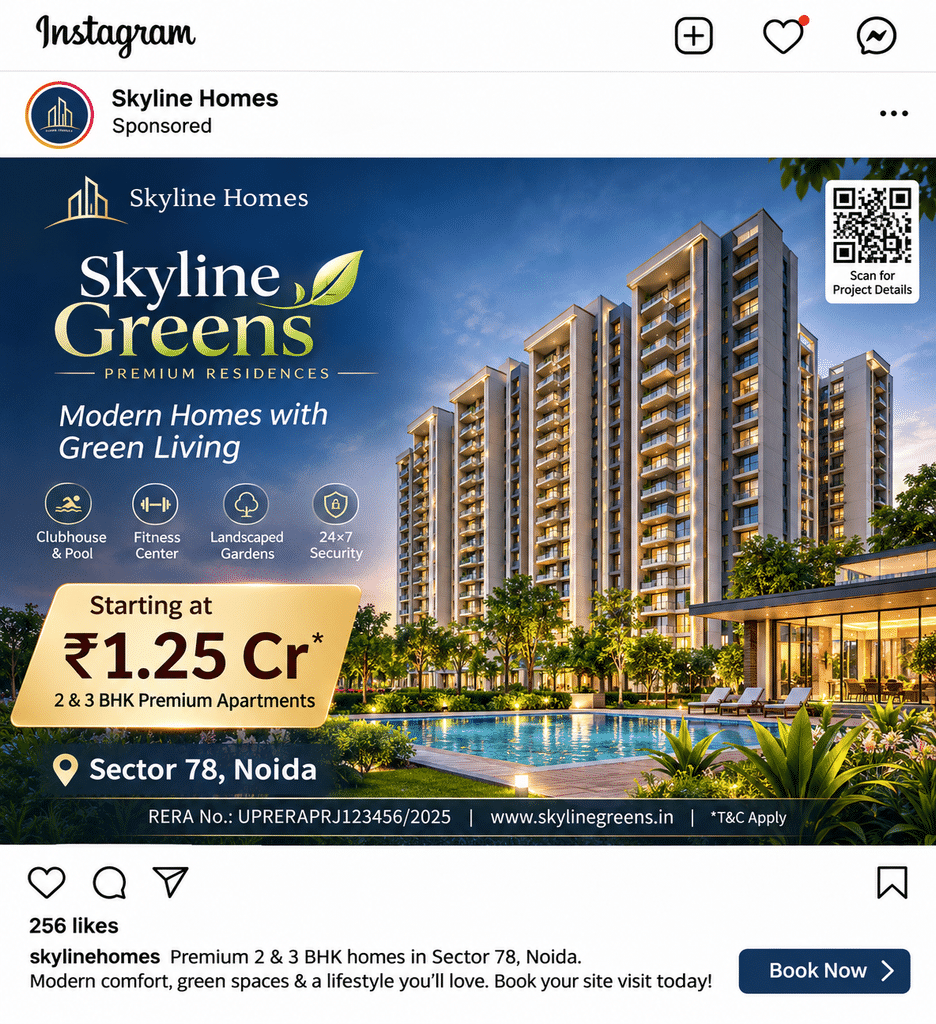
- Registration number and QR code in every ad (state rules). MahaRERA has required the project registration number and QR code on advertisements since 1 August 2023, and by July 2024 it had fined 628 projects a total of about ₹88.9 lakh for not displaying them. An April 2025 order reportedly tightened this further: the QR code and registration number must be clearly visible in all formats, including digital and social media ads, with penalties of up to ₹50,000. Kerala RERA has required a QR code on project promotions and advertisements since 1 September 2023. Check your state authority’s current order before launching any campaign.
- NRI targeting changes the platform rules. Google restricts age, gender, parental status, marital status and ZIP-code targeting for housing ads shown in the United States and Canada. Meta applies its Housing special ad category restrictions — no age or gender selection, limited detailed targeting, no lookalikes — to ads that reach the US, Canada or Europe. A campaign aimed only at buyers in India is generally not affected, but an NRI campaign targeting Dubai and Toronto will be treated differently in each country. Plan separate campaigns.
- Lead data is personal data. Phone numbers and budgets collected from forms fall under India’s Digital Personal Data Protection Act. Be clear in the form about who is collecting the data and why, keep consent records, and don’t share lead lists with third parties without a lawful basis.
What to measure instead of cost per lead
| Metric | Formula | Why it matters |
|---|---|---|
| Cost per lead (CPL) | Ad spend ÷ leads | Useful for comparing ads within one channel, misleading across channels |
| Contact rate | Leads reached on phone ÷ total leads | Low rates point to fake numbers or slow follow-up |
| Qualified lead rate | Qualified leads ÷ leads reached | Shows whether targeting and creative are attracting the right buyers |
| Cost per site visit | Ad spend ÷ completed site visits | The most practical benchmark for residential campaigns |
| Cost per booking | Total marketing spend ÷ bookings | The number that should guide budget decisions |
A simple example: Campaign A delivers leads at ₹400 each and Campaign B at ₹900. If 2% of A’s leads visit the site and 8% of B’s do, A costs ₹20,000 per site visit and B costs about ₹11,250. B is the better campaign, even though it looks twice as expensive in the ad dashboard. (These numbers are illustrative, not benchmarks.)
Common real estate lead generation mistakes
- Running one campaign for every project and location, which makes it impossible to tell what works.
- Judging an agency or a channel only on CPL.
- Leaving leads in a spreadsheet or email inbox instead of a CRM with instant alerts.
- Advertising without the RERA number and QR code, or advertising before registration.
- Turning campaigns off and on every few days, which resets the platforms’ learning and makes results erratic.
- Ignoring the website. Many buyers check the project online after seeing an ad; a slow page with no prices or floor plans loses them.
Frequently asked questions
Why are my Facebook real estate leads fake or unreachable?
Usually because the form is too easy to submit and the campaign is optimised only for form fills. Switch to the “Higher intent” form type, add one or two qualifying questions, show the price in the ad, and upload CRM outcomes so Meta learns which leads became site visits. Some unreachable leads are unavoidable, but a high share points to setup problems.
Is it better to buy leads from property portals or run my own ads?
They do different jobs. Portals reach people actively comparing properties and suit resale, rentals and ready inventory, but enquiries may also go to competitors. Your own ads give you exclusive leads, control over targeting and data you can use to improve campaigns. Most developers use both and compare cost per site visit.
How quickly should a sales team call a new property lead?
As fast as practically possible — ideally within minutes during working hours. Buyers often enquire about several projects in one sitting, and the first project to call usually gets the conversation. An instant WhatsApp message with the brochure helps cover the gap until the call happens.
Do I need to show the RERA number in Facebook and Instagram ads?
In states like Maharashtra and Kerala, the authorities require the registration number and/or QR code on all advertisements, and MahaRERA’s rules explicitly cover digital and social media ads. Other states have their own orders. Treat it as mandatory unless your state authority says otherwise, and confirm the current format requirement before launch.
Are click-to-WhatsApp ads good for real estate?
They can be, especially in India where buyers are comfortable sharing and receiving brochures, videos and location pins on WhatsApp. Because the buyer starts the conversation, intent is often higher than with instant forms. They only work if someone replies quickly, so plan staffing or automated first replies before launching.
How long does it take for real estate SEO to generate leads?
For a new project page, expect several months before it ranks for competitive location and configuration searches. Developers with multiple projects in one city benefit most, because each new project builds on the authority of the main site. SEO works best alongside paid ads, not as a replacement during a launch.
Can I target NRIs for an Indian property project?
Yes, but platform rules change by country. Ads reaching the US, Canada or Europe fall under Google’s and Meta’s housing restrictions, which limit age, gender and some location targeting. Gulf markets have different rules. Run NRI campaigns separately from domestic ones and build creative around what NRIs need: legal clarity, remote site visits and home-loan information.
What should I look for in a real estate lead generation agency?
Ask how they measure success. A good agency will talk about site visits and bookings, insist on CRM access or regular lead-outcome feedback, follow RERA disclosure rules in every ad, and explain how they filter junk leads. Be cautious of anyone guaranteeing a fixed number of leads at a fixed price without knowing your project and price point.
Turning leads into site visits
Better real estate lead generation in India is less about finding a magic channel and more about running a tight system: clear targeting, ads that show price and location, forms with sensible friction, a CRM that alerts sales instantly, consistent qualification, and site-visit data fed back to the ad platforms. Add RERA-compliant creative and separate NRI campaigns, and you remove most of the reasons leads go to waste.
If you’d like an outside view of your current campaigns, our team can review your ad accounts, landing pages and lead flow. Start with a free website audit, or see how we approach digital marketing for real estate businesses.