
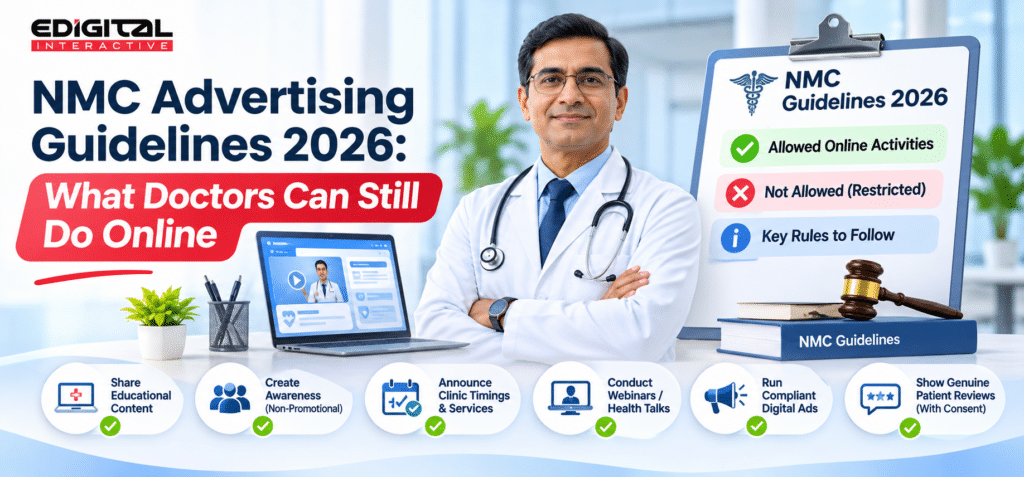
On 6 October 2026, the National Medical Commission issued a public notice titled “Guidelines on Ethical Advertising and Public Communication”. It took effect immediately, with no grace period, and it is the first NMC document to deal directly with social media, Google reviews, influencer content and AI-generated posts.
The short answer for most doctors: you can still be found online, publish a factual profile, state your fees and educate the public. What you can’t do is promote yourself — no testimonials, no before-and-after photos, no “best doctor” claims, no discounts, no fake or solicited reviews, and no AI-made content passed off as real. This guide explains what changed, how it applies to each channel you use, which questions remain open, and what to fix first.
This article explains the guidelines in plain language. It is not legal advice. For decisions about your own practice, speak to a lawyer or your State Medical Council.
What did the NMC issue in October 2026?
The notice (No. R-13014/01/2024-Ethics, dated 6 October 2026) sets out guidelines that are read together with the Indian Medical Council (Professional Conduct, Etiquette and Ethics) Regulations, 2002. Those 2002 regulations are still the operative code of conduct: the NMC’s newer 2023 professional conduct regulations were put in abeyance in August 2023 and the 2002 rules were restored.
What the 2026 notice adds is detail. The 2002 code banned soliciting patients “directly or indirectly”, but it was written before Instagram reels and Google Maps reviews existed. The new guidelines define advertising to include digital, social media, sponsored, influencer-led, search-engine and AI-generated content whenever it has a promotional character. In other words, the platform doesn’t matter — the purpose does.
Who do the guidelines apply to?
They apply to registered medical practitioners (RMPs). The notice also says healthcare platforms that list doctors must comply, and that using an agency, influencer or platform does not shield a doctor from responsibility for content they authorised or knowingly allowed. If your agency posts a testimonial on your clinic’s page, it is your page and your liability.
Hospitals and institutions are addressed in a separate section. Institutional communication — a hospital’s own departments, facilities and doctor directory — is treated differently from an individual doctor promoting themselves. A hospital doctor directory listing names, qualifications, specialities, registration and availability is described as patient information, distinct from advertising.
What is no longer allowed
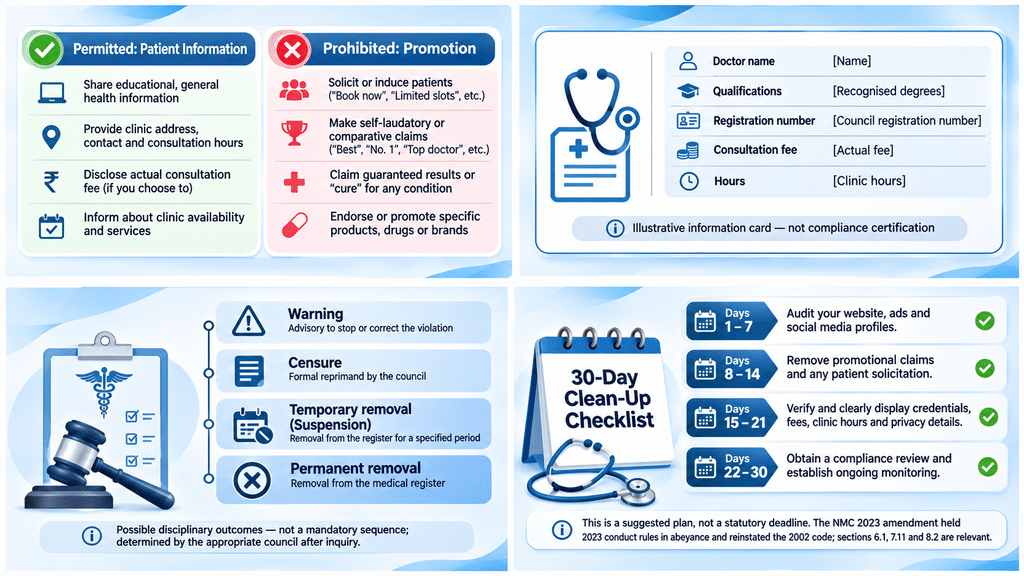
Based on the published text, these are the practices the guidelines prohibit or heavily restrict:
- Patient testimonials. Doctors should not request or share patient testimonials for promotion on social media. Patient consent alone does not make a testimonial, a success story or a before-and-after depiction acceptable.
- Before-and-after photos. Prohibited for promotion. Use is limited to scientific or educational purposes, with anonymisation and consent.
- Superlatives and success rates. “Best doctor”, “No. 1 specialist”, “100% success”, patient counts and personal achievement claims are out, unless a comparative claim can be objectively verified by a transparent method — a high bar in practice.
- Fake, paid or manipulated reviews and engagement. No fake followers, likes, ratings or reviews, and no manipulating search rankings or algorithms to create a misleading impression.
- Offers and inducements. Discounts, limited-period offers, coupons, cashback, referral benefits and “free” procedures are prohibited where they encourage unnecessary care.
- Fear-based marketing. Content that creates anxiety to drive demand for procedures or tests.
- Per-patient payments. No commission, referral fee or lead-generation fee tied to referring patients — and agency, influencer or platform deals must not be structured so payment is linked to individual patients.
- Synthetic AI content. AI must not be used to create fake testimonials, patient outcomes or similar. Promotional AI content must carry a mark stating it is AI-generated.
- Identifiable patient information. No public use of patient data that can identify someone.
- Undisclosed commercial relationships. Paid partnerships must be disclosed, and a third party can’t be used to do indirectly what the doctor can’t do directly.
What doctors can still do
The notice is not a blanket ban on being online. It explicitly allows factual, non-promotional communication, including:
- Formal announcements such as starting a practice, changing the type of practice, moving address, temporary absence, resuming practice and succeeding to a practice.
- A public declaration of charges. You can state consultation and procedure fees, as long as they are factual and not framed as an offer.
- Public health education — talks, articles and patient leaflets in your own name, without guarantees of cure or claims of superiority.
- Factual electronic profiles showing your name, qualifications, registration status and State Medical Council or NMR registration number. The notice says doctors posting electronically must disclose these.
A useful test before publishing anything: does this help a patient make an informed decision, or does it try to persuade them to choose me? The first is information. The second is advertising.
Channel-by-channel: what the guidelines mean in practice
| Channel | Generally fine | Avoid |
|---|---|---|
| Clinic or doctor website | Name, qualifications, registration number, specialities, clinic address and hours, fees, how to book, condition and procedure explainers written for patients | Testimonial sliders, before-and-after galleries, “best in city” headings, patient counts, success-rate badges, offer banners |
| Google Business Profile | Accurate registered name (no keywords stuffed in), correct address, phone, hours, categories, real photos of the premises; neutral, polite replies to reviews that don’t reveal patient details | Review drives, incentives for reviews, posting offers, buying or swapping reviews, fake listings for extra locations |
| Instagram, Facebook, YouTube | Health-awareness posts, myth-busting, explainers, clinic timings and announcements, with your name and registration details visible on the profile | Patient stories and video testimonials, transformation reels, giveaway or discount posts, paid influencer shout-outs without disclosure |
| AI-assisted content | Using AI to help draft patient education, reviewed by the doctor, with an AI label where the content is promotional | AI-generated “patients”, voices, testimonials, outcome images or invented credentials |
| Third-party platforms (Practo, JustDial etc.) | Factual listings | Paid ranking above other doctors — the notice says platforms must not offer this |
| Paid search and social ads | Unclear for individual doctors (see below) | Any ad that promotes an individual doctor, uses superlatives or offers, or is paid per patient |
What is still unclear
Several questions doctors ask most often don’t have a clean answer in the text. Where commentators disagree, it usually comes down to one of these:
Can doctors ask patients for Google reviews?
The guidelines ban fake, paid and misleading reviews and say doctors should not request or share testimonials for promotion. Whether a neutral “please review us” request to a genuine patient counts as soliciting is not spelled out. Several healthcare consultancies now advise against review drives, QR-code “rate us” stands and follow-up review messages until the NMC or a State Medical Council clarifies. That is the cautious position, and it’s the one we’d recommend.
Can an individual doctor run Google Ads or Meta Ads?
The notice doesn’t name Google Ads or Meta, but its definition of advertising covers search-engine, sponsored and targeted content, and it prohibits solicitation and self-promotion. A paid campaign promoting an individual doctor looks hard to square with that. Hospitals have more room for institutional communication, but even there, ads should be factual, avoid superlatives and offers, and comply with Google’s own healthcare policies. Separately, Google already prohibits advertisers targeting India from promoting prescription drugs in ads or landing pages.
Can a doctor hire a digital marketing agency?
This is the most debated point. The guidelines list engaging a third party to market medical services among prohibited acts for individual practitioners, while also accepting that agencies and platforms exist and making the doctor responsible for what they publish. A reasonable reading is that agencies can still help with things that are not promotion — building a fast, accessible website, keeping listings accurate, technical SEO, privacy-compliant appointment forms, and editing doctor-reviewed health education — but should not be engaged to solicit patients, and should never be paid per patient or per lead. Get legal advice before signing any marketing contract for an individual practice.
What about content published before 6 October 2026?
The notice doesn’t provide a transition period. Anything still visible on your website or social profiles is live communication today, so older testimonial videos and offer posts are the first thing to review.
Penalties for violations
The guidelines set out graded action by State Medical Councils:
| Violation | Action |
|---|---|
| First | Warning and ethics training |
| Second | Censure and monetary penalty |
| Third | Suspension for 3–6 months |
| Serious violations, including digital mass solicitation | Suspension for 6–12 months |
| Repeated violations | Removal from the register for 1–3 years |
Medical advertising is also covered by other laws — the Drugs and Magic Remedies (Objectionable Advertisements) Act, 1954, the Consumer Protection Act, 2019 and the CCPA’s guidelines on misleading advertisements — and by the ASCI code. The NMC guidelines sit on top of these, not instead of them.
A 30-day clean-up plan for your practice
- Week 1 — Remove the high-risk items. Take down patient testimonials, before-and-after images, discount and package-offer posts, and any “best”, “No. 1” or “100%” claims from your website, Google Business Profile posts and social profiles.
- Week 1 — Stop review campaigns. Pause review-request messages, QR stands and any incentive linked to reviews. Keep replying to existing reviews neutrally, without confirming that the reviewer is a patient.
- Week 2 — Fix your profiles. Add your full name, qualifications and registration number to your website, social bios and listings. Correct your Google Business Profile name to your registered name.
- Week 2 — Review contracts. If you pay an agency, influencer or platform, check that nothing is linked to patient numbers or leads, and that sponsored content is disclosed.
- Week 3 — Rebuild around education. Replace removed content with patient-education pages and posts: what a condition is, when to see a doctor, what to expect from a procedure, how to prepare. This is useful to patients, allowed by the guidelines and still helps people find you in search and AI answers.
- Week 4 — Set an approval rule. Nothing goes live without the doctor’s review. Keep a simple log of what was published, when and who approved it. Label promotional AI-assisted content.
Frequently asked questions
Are the NMC 2026 guidelines in force or still a draft?
The notice states that it comes into force with immediate effect and on the date of its publication by the NMC. It was dated 6 October 2026. Commentary since then treats it as in force, and no clarification or withdrawal had been reported as of late November 2026. Check the NMC website for any later notices.
Can I display my consultation fees online?
Yes. A public declaration of charges is listed as a permitted announcement. Keep it factual — “Consultation: ₹800” is fine. “Flat 30% off this week” or “free first consultation” framed as an offer is not, because the guidelines prohibit discounts and inducements that may encourage unnecessary care.
Can I post a photo of myself on my website or Instagram?
The guidelines say a doctor’s photograph is not permitted where it amounts to self-advertisement, and refer to the 2002 regulations for letterheads and signboards. A professional profile photo on an information page is lower risk than a promotional banner featuring you. If you’re unsure, ask your State Medical Council.
Can I share a patient’s success story if they consent?
Not for promotion. The guidelines say consent alone does not make a testimonial, success claim or before-and-after depiction acceptable. Anonymised case discussions for genuine scientific or educational purposes — such as a conference presentation or a journal article — are treated differently.
Do AI-written health posts need a label?
Promotional content created with AI must carry a mark stating it is AI-generated. The notice doesn’t prescribe the exact format. A short line such as “Created with AI assistance and reviewed by Dr [Name]” is a sensible approach. AI must never be used to create synthetic patients, testimonials or outcomes.
Do the guidelines apply to hospitals as well as individual doctors?
Yes, but differently. Hospitals are covered by a separate section on institutional communication, and a factual doctor directory is treated as patient information. Hospitals still can’t use testimonials, offers, superlatives or per-patient payments, and the doctors who work there remain individually bound by the rules.
Is SEO still allowed for doctors?
Making accurate, helpful information easy to find is not prohibited. Technical improvements, clear service pages and patient-education content are generally fine. What the guidelines target is manipulation — fake listings, doorway pages built around “best doctor” phrases, and any tactic meant to create a misleading impression in search results.
What happens if a patient leaves a fake negative review?
You can report it to the platform through its normal review-reporting process. Reply calmly and generally, without disclosing any patient information or confirming whether the person was treated by you, since patient confidentiality still applies in public replies.
Information first, promotion never
The October 2026 guidelines don’t take doctors offline. They draw a firm line between helping patients understand their options and persuading them to choose you. Factual profiles, clear fees, accurate listings and genuinely useful health education are all still available — and they are also what search engines and AI assistants tend to surface when patients ask health questions. The work now is to remove what crosses the line, put registration details everywhere you appear, and set up a review step before anything is published.
If you’d like a second pair of eyes on your website and listings, our team can run a free website audit focused on technical health, accessibility and content that may need review under the new guidelines. For legal sign-off, always involve your own adviser.