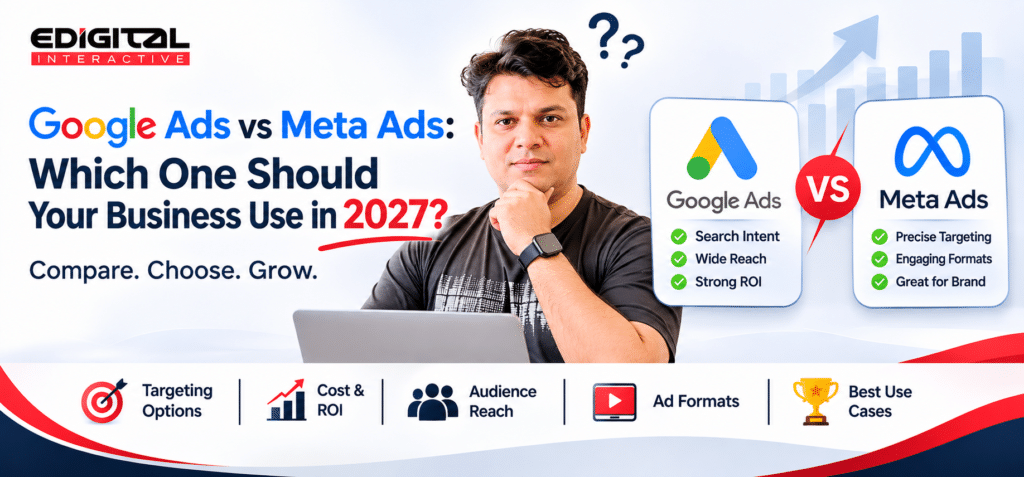
If you’re choosing between Google Ads and Meta Ads, here’s the short answer. Google Ads is usually the better first choice when people already search for what you sell, because you reach them at the moment they’re looking. Meta Ads (Facebook and Instagram) is usually better when people don’t search for your product yet, or when your product sells on looks, story or impulse. Most growing businesses end up using both, but not in equal amounts, and rarely from day one.
The harder questions are which one to start with, how much to put in each, and how to tell which is really bringing you customers. Both platforms will report that they’re doing a great job. This guide gives you a way to decide using your own numbers instead.
The real difference: intent vs interest
Google Ads and Meta Ads aren’t two versions of the same thing. They solve different problems.
Google Ads captures demand. Someone types “dermatologist in Noida” or “CA for GST registration” and your ad appears. You pay to be in front of a person who has already decided they need something. The limit is that you can only reach as many people as are searching.
Meta Ads creates demand. Nobody opens Instagram to look for a new skincare brand or a weekend villa project. Meta shows your ad to people its system predicts will respond, based on their behaviour across Facebook, Instagram and WhatsApp. You can reach far more people, but most of them weren’t planning to buy today.
That one difference explains almost everything else: why Google clicks cost more, why Meta leads need more follow-up, and why the right mix depends on your product.
Google Ads vs Meta Ads at a glance
| Google Ads | Meta Ads | |
|---|---|---|
| How you reach people | Keywords and search intent (plus YouTube, Display, Demand Gen) | Audience prediction across Facebook, Instagram, Messenger and WhatsApp entry points |
| Buyer stage | Mostly ready to compare or buy | Mostly not looking yet |
| What you usually pay for | Clicks (on Search) | Impressions, even when optimising for leads or sales |
| Cost per click | Higher | Lower |
| Lead quality | Usually higher intent | More variable; needs qualifying |
| Main growth limit | Search volume for your keywords | Creative quality and freshness |
| Biggest success factor | Keyword choice, landing page, conversion tracking | Creative, offer, conversion tracking |
| GST in India | 18% GST is added to ad spend on both platforms’ invoices; usually claimable as input tax credit if your GSTIN is on the billing profile [VERIFY with CA] | |
For actual price ranges, see our guides to Google Ads cost in India and Meta Ads cost in India. We don’t repeat those numbers here because a cheaper click is not the same as a cheaper customer.
When Google Ads is the better choice
Start with Google if most of these are true:
- People search for your service by name. Plumbers, lawyers, diagnostic labs, CA firms, B2B software, coaching for a specific exam, “flats in Sector 150”.
- The need is urgent. When something breaks, hurts or has a deadline, people search first.
- Each customer is worth a lot. A ₹40 click is fine if one in 30 clicks turns into a ₹50,000 contract.
- You sell locally. Search and Maps results catch people nearby who want to visit or call now. Pair ads with a well-maintained Google Business Profile, as covered in our local SEO guide.
The catch is the ceiling. If only 800 people a month search for your service in your city, no budget will buy you 2,000 search clicks. Once you’re showing for most relevant searches, extra spend mostly raises your cost per click.
When Meta Ads is the better choice
Start with Meta if most of these are true:
- Your product is visual or impulse-driven. Fashion, beauty, food, home décor, gifts, travel, events.
- People don’t search for your category yet. A new product type, a new brand or a D2C product competing with marketplace listings.
- You can describe your buyer but they aren’t searching. New parents, people who just moved cities, small business owners, NRIs.
- You have a steady supply of creative. Meta’s delivery system now leans heavily on the ad creative itself to find the right people, so fresh images and short videos matter more than detailed targeting.
Meta’s reach in India is large. NapoleonCat’s estimates, compiled from Meta’s advertising tools, put Instagram’s addressable audience in India at about 570 million in October 2026, with roughly three-quarters aged 18 to 34. That reach is why Meta can feed a business with leads even when search volume is small.
The catch is lead quality. Meta Instant Forms are easy to fill in, so some people submit them without much thought. Add one or two qualifying questions, call leads quickly, and judge Meta on qualified leads, not form fills.
What changed in 2026
Both platforms have handed more decisions to automation, and that changes how you run them.
Google: AI Max for Search campaigns, launched in 2025, matches your ads to searches beyond your exact keywords using your landing pages and creative. Google expanded it in April 2026 to Shopping and travel campaigns. Google is also testing ads inside AI Mode and AI Overviews, served through existing Performance Max, Shopping and broad-match Search campaigns rather than a separate campaign type. Availability varies by country and account. [VERIFY India availability on Google Ads help centre on publish day] In practice, check your search terms report more often, because “smart” matching can wander far from what you sell.
Meta: Meta’s ad delivery systems (it calls the retrieval system Andromeda) have shifted from audience-first to creative-first. Practitioners report that heavy interest targeting and many small ad sets now perform worse than broad audiences with a variety of creatives. The practical result: your creative pipeline is now your targeting.
What hasn’t changed: both systems optimise for whatever conversion you send them. Feed them form fills and they’ll find people who fill forms. Feed them qualified leads or sales from your CRM and they’ll find buyers.
Which is better for your type of business?
| Business type | Usually start with | Why |
|---|---|---|
| Local services (clinics, salons, repairs, CA/legal) | High-intent “near me” and service searches. Note that doctors must follow NMC rules on advertising. | |
| B2B services and software | Google (then LinkedIn) | Buyers search for solutions; Meta’s job-title audiences are thin and expensive |
| D2C and ecommerce | Meta | Visual products, impulse purchases, little branded search at the start |
| Real estate | Both | Google for project and location searches; Meta for reach and NRI audiences. See our real estate lead generation guide. |
| Education and coaching | Both | Google for exam- and course-specific searches; Meta for parents and students who haven’t started looking |
| Restaurants, events, launches | Meta | Time-bound offers that need awareness quickly |
Treat this as a starting point, not a rule. Your own cost per qualified lead should overrule any table, including this one.
How to split your budget between Google and Meta
Fixed percentages like “60/40” are easy to repeat but ignore the one constraint that matters most: how much search demand exists for you. Use this method instead.
- Size the search ceiling. Use Google’s Keyword Planner to estimate monthly searches for your high-intent keywords in your target area. Multiply by a realistic click share and your expected cost per click. That’s roughly the most Google Search can usefully absorb.
- Fund Search up to that ceiling first if you’re a search-driven business. These are the people closest to buying.
- Put the next layer into Meta to reach people who aren’t searching yet, and to retarget site visitors.
- Give each platform enough to learn. Meta’s guidance is that an ad set needs around 50 optimisation events a week to leave its learning phase. Google’s smart bidding also needs steady conversion volume. Splitting a small budget across too many campaigns starves both. [VERIFY current figures on publish day]
- Review monthly on cost per qualified lead and move money towards whichever platform is cheaper at that level, until it hits its ceiling or its costs start rising.
A worked example
Take a Noida dental clinic with ₹60,000 a month to spend (before GST). These numbers are illustrative, not benchmarks.
| Google Search | Meta | |
|---|---|---|
| Ad spend | ₹40,000 | ₹20,000 |
| Leads (calls + forms) | 80 | 120 |
| Cost per lead | ₹500 | ₹167 |
| Qualified leads (reachable, real need) | 56 (70%) | 30 (25%) |
| Cost per qualified lead | ₹714 | ₹667 |
| Booked appointments | 28 | 12 |
| Cost per appointment | ₹1,429 | ₹1,667 |
On cost per lead, Meta looks three times cheaper. On cost per qualified lead, the two are almost level. On cost per booked appointment, Google wins. If the clinic had only looked at the platform dashboards, it would have moved money the wrong way. The right next step here is to check whether Google can absorb more spend without its cost per click rising, and to improve Meta’s lead form with a qualifying question.
How to measure which platform is really working
This is where most comparisons go wrong. Google and Meta each use their own attribution. If someone sees your Instagram ad on Monday, searches your brand on Thursday and clicks a Google ad, both platforms may count that one lead. Add up the conversions in both dashboards and you’ll often find more leads than you actually received.
A more honest setup:
- Track every lead in one place. A CRM, or even a shared sheet, with the source captured through UTM parameters, call tracking numbers and form fields.
- Mark lead quality. Qualified, not reachable, wrong fit, converted. This takes your sales team a few seconds per lead and is the most valuable data you’ll have.
- Send quality back to the platforms. Use Google’s offline conversion import and Meta’s Conversions API to report qualified leads or sales, so both systems optimise for customers rather than form fills.
- Use GA4 as a neutral referee. Set up key events properly and compare platforms on the same attribution model. Our Google Analytics services cover this setup.
- Watch branded search. If Meta campaigns are working, searches for your brand name usually rise. Some of the leads Google takes credit for were started by Meta.
Don’t forget WhatsApp
For many Indian businesses, the best Meta format isn’t a form or a website visit. Click-to-WhatsApp ads open a chat with your business directly. People who start a conversation are often easier to qualify than form leads, and your team can answer questions immediately. The trade-off is that chats need fast replies and are harder to track, so log each chat’s outcome in your CRM. Google can also drive calls and messages through call assets and lead forms, but WhatsApp is where Meta has a clear edge in India.
Common mistakes when choosing between Google and Meta
- Judging Meta by Google’s standards. Meta leads are earlier in the journey. Give them follow-up, not a single call.
- Running Google on broad keywords with no negatives. Automated matching makes regular search-term reviews more important, not less.
- Splitting a small budget across both platforms too early. With ₹20,000 a month, one platform done properly beats two done thinly.
- Sending ads to the homepage. Both platforms perform better with a focused landing page that matches the ad.
- Trusting platform-reported ROAS. Compare against your actual sales or CRM data.
Frequently asked questions
Which is better for lead generation, Google Ads or Facebook Ads?
Google Ads usually produces higher-intent leads because people are actively searching. Facebook and Instagram ads usually produce more leads at a lower cost per lead, but fewer of them are ready to buy. Compare the two on cost per qualified lead or cost per customer, not cost per lead.
Should a small business start with Google Ads or Meta Ads?
Start with Google if customers search for your service, especially for local or urgent needs. Start with Meta if your product is visual, new or not widely searched. With a small budget, pick one platform, set up tracking properly and run it for at least two to three months before adding the second.
Can I run Google Ads and Meta Ads together on a small budget?
You can, but it’s often a mistake. Each platform needs enough conversions to learn. If your budget only supports a handful of leads a week, splitting it means neither platform gets enough data. Run one well, then expand once you know your cost per qualified lead.
Why are Google clicks more expensive than Facebook clicks?
A Google search click comes from someone actively looking for what you sell, so advertisers compete harder for it. Meta charges mainly for impressions, and many people who click are browsing rather than buying. Higher cost per click on Google is often balanced by a higher conversion rate.
Why do Google and Meta both claim the same conversion?
Each platform uses its own attribution and counts conversions from people who interacted with its ads. If someone saw a Meta ad and later clicked a Google ad, both may claim the lead. Use a CRM or GA4 to count each lead once and compare platforms fairly.
Is Instagram advertising part of Meta Ads?
Yes. Instagram, Facebook, Messenger and Audience Network ads are all bought through Meta Ads Manager in one auction. Letting Meta choose placements automatically usually gives cheaper overall delivery than picking Instagram or Facebook alone.
Is YouTube advertising part of Google Ads?
Yes. YouTube, Display, Gmail and Discover placements are bought through Google Ads, often through Demand Gen or Performance Max campaigns. These behave more like Meta, reaching people who aren’t searching, so judge them on the same qualified-lead basis.
How long should I test before deciding which platform works?
Plan for at least 60 to 90 days, with conversion tracking working from day one. The first few weeks include learning periods on both platforms, and many leads, especially from Meta, take weeks to convert. Decide on customers won, not first-week cost per lead.
The bottom line
Google Ads and Meta Ads aren’t rivals so much as two halves of a funnel. Google catches people who already want what you sell; Meta finds people who will want it once they see it. Start with the platform that matches how your customers buy, fund search up to its natural ceiling, and use Meta to grow beyond it. Above all, judge both on qualified leads and customers in your own CRM, not on the numbers each platform reports about itself.
If you want a second opinion on your current split, our performance marketing team can review your Google and Meta accounts and tracking together. Or start with a free website audit to check whether your landing pages are ready for paid traffic.